2026 Topps Chrome Baseball Guide: Rookies, Refractors, Autographs & Box Types Explained
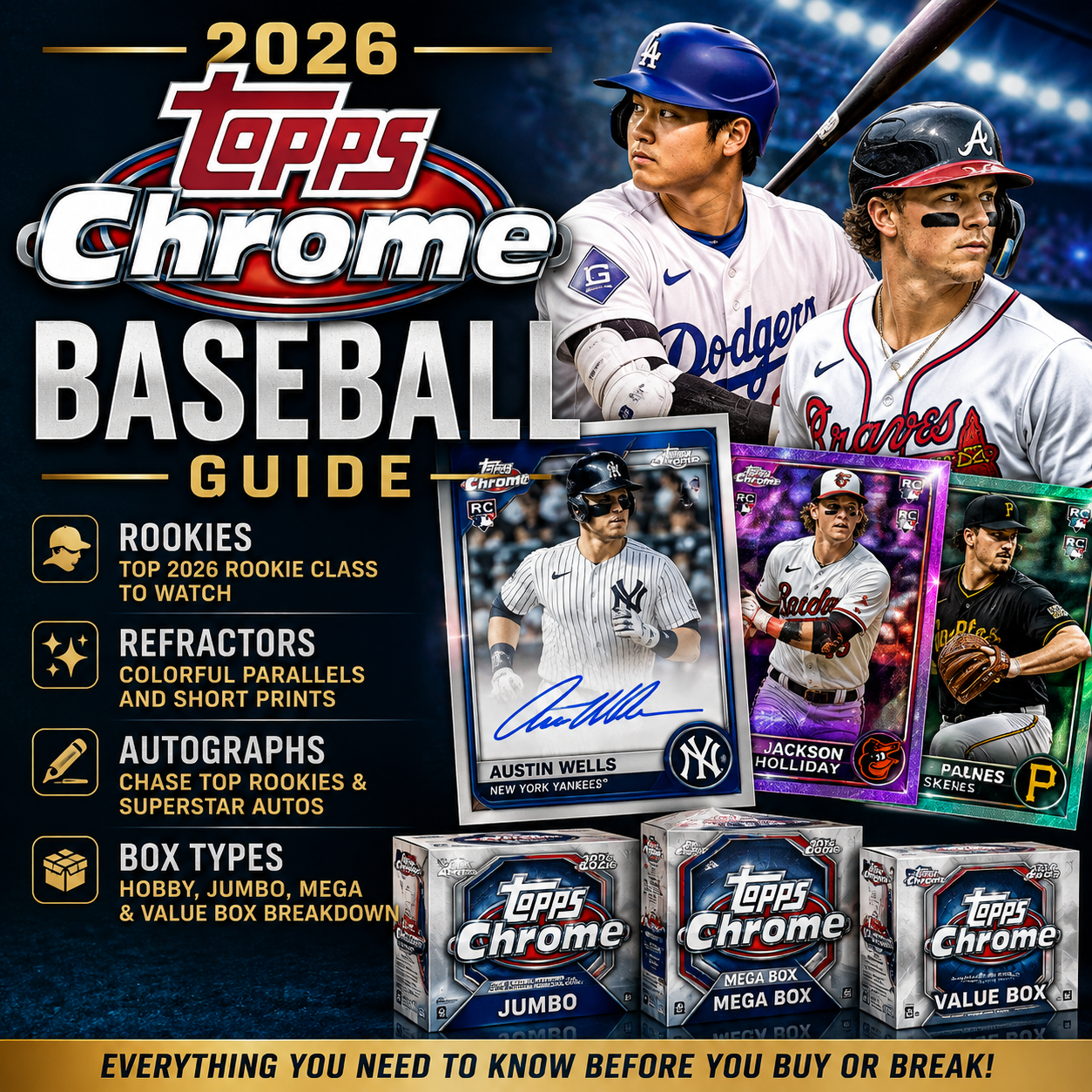
If you collect modern baseball cards, 2026 Topps Chrome Baseball is one of the releases worth paying attention to this summer. The product officially arrived on July 22, while the 2026 Topps Chrome Mega Box became available August 5, giving collectors another way to chase the set.
The 2026 edition combines a 300-card base checklist with rookie cards, veteran stars, inserts, autographs and a deep selection of colorful Refractor parallels. It also brings back the highly sought-after Gold Logoman cards, while introducing new insert themes such as Diamond Moments and Static Noise.
For buyers deciding between a Hobby Box, Jumbo Box, Value Box or Mega Box, however, the biggest question is not simply what is inside? It is which format gives you the best chance of finding the cards you actually want?
This guide breaks down the important parts of the 2026 release, including the 2026 Topps Chrome Baseball checklist, Refractors, rookies, autographs, Gold Logoman chase cards and which box makes the most sense for different types of collectors.
What Is New in 2026 Topps Chrome Baseball?
The basic formula remains familiar: Topps takes the stars, rookies and other players from its flagship baseball releases and gives them the Chrome treatment.
But the 2026 set has several reasons to stand out.
The 300-card base set is the foundation of the release, with stars, rookies and legends appearing on chromium stock. Returning inserts include popular themes such as Helix, Ultraviolet and World Series at Night, while 2026 adds Diamond Moments and Static Noise to the insert lineup.
There is also a strong rookie focus. The product includes players such as Munetaka Murakami, Sal Stewart, Cam Schlittler and Trey Yesavage, while the broader rookie chase has generated significant interest among collectors.
Another major attraction is the return of Gold Logoman cards, including relics, autographs and autograph relics connected to winners of MLB's major 2025 awards.
In other words, this year's release is not simply about collecting the base set. There are several layers to chase depending on whether you prefer rookies, color parallels, inserts, autographs or extremely rare cards.
2026 Topps Chrome Baseball Box Types Compared
One of the most important decisions is choosing the right box.
The different formats are designed around different collecting experiences. A collector primarily interested in autographs should approach the product differently from someone who wants to build a Refractor rainbow or simply open Chrome cards without spending several hundred dollars.
Hobby Box
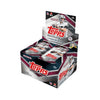
The Topps Chrome Baseball hobby box contains 20 packs with four cards per pack, for 80 cards total, and includes one autograph per box according to Topps' current configuration.
This makes Hobby the traditional choice for collectors who want access to the core Chrome chase and a guaranteed autograph slot.
Major Sports Cards currently lists the 2026 Topps Chrome Baseball Hobby Box, although availability can change quickly as boxes sell through.
Best for: collectors who prioritize autograph opportunities, hobby-exclusive parallels and a more traditional premium box-opening experience.
Jumbo Box
The Jumbo format dramatically increases the amount of Chrome in a single box.
The 2026 Topps Chrome Jumbo Box contains 12 packs with 11 cards per pack, or 132 cards, and guarantees two autographs per box.
Jumbo also has its own Wave Refractor family. Collectors can find Wave versions progressing through Blue, Green, Purple, Gold, Orange, Black and Red tiers.
That makes Jumbo particularly interesting for collectors who want both more cards and additional autograph exposure.
Best for: serious collectors, autograph chasers and collectors building large Chrome sets or parallel collections.
Value Box
The Value Box offers a considerably cheaper entry into 2026 Topps Chrome.
The current Major Sports Cards listing shows 7 packs with 4 cards per pack, giving collectors 28 cards in the box. It also highlights retail-focused content such as Red White & Blue parallels, Baseball Seams parallels and Lightboard Logo Variations.
Unlike Hobby and Jumbo, Value Boxes should not be approached primarily as an autograph product. Their appeal is access to Chrome's base cards, rookies, inserts and retail-exclusive parallel opportunities at a lower entry price.
Best for: newer collectors, budget-conscious buyers, set builders and collectors who enjoy opening multiple smaller boxes.
Mega Box
The Mega Box became available August 5, making it particularly relevant for collectors shopping in August. Topps lists the Mega configuration at 6 packs with 7 cards per pack, or 42 cards per box.
Mega Boxes have their own X-Fractor parallel family, including numbered Aqua, Blue, Green, Purple, Gold, Orange, Black and other X-Fractor variations.
Major Sports Cards is also carrying the 2026 Topps Chrome Baseball Mega Box, with the current listing showing the product as available while supplies last.
Best for: collectors who want a retail format with its own parallel chase and more cards than a Value Box.
Quick Box Comparison
| Box | Configuration | Main Attraction | Best For |
|---|---|---|---|
| Hobby | 20 packs × 4 cards | 1 autograph | Hobby collectors and autograph chasers |
| Jumbo | 12 packs × 11 cards | 2 autographs | Serious collectors |
| Value | 7 packs × 4 cards | Retail-exclusive parallels | Budget collectors |
| Mega | 6 packs × 7 cards | X-Fractors | Retail parallel hunters |
Configurations and guarantees are based on current Topps and retailer listings and can be subject to product updates.
What Is a Refractor?
If you are new to Topps Chrome, the word Refractor will appear everywhere.
A Refractor is essentially a parallel version of a base card. It uses the Chrome finish but has a distinctive reflective appearance that separates it from the standard base version.
The important part is that there is not just one Refractor.
There is an entire Refractor rainbow.
The standard 2026 checklist includes an unnumbered Refractor along with Negative and numerous numbered color variations. The numbered ladder moves through Pink /250, Aqua /199, Blue /150, Green /99, Purple /75, Gold /50, White /30, Orange /25, Black /10 and Red /5, before reaching the 1/1 Superfractor.
The smaller the number, generally, the scarcer the card.
For example:
- Pink Refractor — /250
- Aqua Refractor — /199
- Blue Refractor — /150
- Green Refractor — /99
- Purple Refractor — /75
- Gold Refractor — /50
- White Refractor — /30
- Orange Refractor — /25
- Black Refractor — /10
- Red Refractor — /5
- Superfractor — 1/1
There are also format-specific versions such as Wave, Raywave, X-Fractor, Geometric and Baseball Seams Refractors.
Why Do Collectors Chase Refractor Rainbows?
Collectors often try to find the same player in multiple parallel versions.
For example, someone collecting a particular rookie might want:
Base → Refractor → Blue /150 → Green /99 → Gold /50 → Orange /25 → Red /5 → Superfractor 1/1
That is called building a rainbow.
The challenge is that the rarest versions can become extremely difficult to locate, particularly for popular rookies and superstar players.
Important 2026 Topps Chrome Parallel Types
Not every parallel is equally important to every collector.
Gold Refractors
Gold Refractors are numbered to /50 and sit well into the scarce portion of the standard Chrome rainbow.
A Gold Refractor of a desirable rookie or superstar can be much more interesting to collectors than an unnumbered parallel.
Orange Refractors
Orange Refractors are numbered to /25.
With only 25 copies in the standard parallel run for a player, these are considerably scarcer than Gold Refractors.
Black Refractors
Black Refractors are numbered to /10.
These are the type of cards collectors generally want to inspect carefully when they pull one of a major rookie or superstar.
Red Refractors
Red Refractors are numbered to /5.
At this level, player popularity, condition and the overall desirability of the card can become especially important.
Superfractors
The ultimate standard Chrome rainbow chase is the Superfractor 1/1.
A 1/1 means there is only one copy of that specific card in the parallel run. The 2026 checklist also includes one-of-one Printing Plates.
Finding a Superfractor of a major rookie can be one of the biggest pulls available in the product.
What About Wave, Raywave and X-Fractors?
This is where box selection becomes even more important.
Different formats provide access to different parallel families.
Jumbo Boxes have Wave Refractors, including Blue Wave /150, Green Wave /99, Purple Wave /75, Gold Wave /50, Orange Wave /25, Black Wave /10 and Red Wave /5.
Value Boxes provide retail-specific options including Raywave and Baseball Seams Refractors, while Mega Boxes bring X-Fractors into the mix.
So if you are chasing a particular parallel style, the box you purchase matters.
You should always check the current odds and checklist before buying specifically for one parallel because configurations and odds can vary by format.
2026 Topps Chrome Baseball Rookie Cards
Rookies are one of the biggest reasons collectors buy Chrome.
The 2026 release has a substantial rookie focus, and the checklist includes players who have already generated attention from collectors and prospect followers.
Among the names highlighted by current collector guides are Munetaka Murakami, Sal Stewart, Cam Schlittler and Trey Yesavage.
The broader rookie conversation also includes players such as Kevin McGonigle, JJ Wetherholt, Carson Benge and Justin Crawford, who moved from Series 2 short-print appearances into the regular Chrome base checklist.
The key point for collectors is simple:
Do not judge a rookie card only by the player's current popularity.
A rookie's long-term card value can change dramatically based on:
- MLB performance
- Playing time
- Awards and accomplishments
- Team market
- Collector demand
- Autograph availability
- Parallel scarcity
- Card condition
A rookie base card may be inexpensive today while a low-numbered rookie Refractor or rookie autograph could become much more desirable if the player develops into a star.
2026 Topps Chrome Baseball Autographs
Autographs remain one of the central attractions of the product.
Topps describes the 2026 release as delivering some of the first on-card signatures from the 2026 rookie class.
Hobby Boxes contain one autograph, while Jumbo Boxes contain two.
The autograph checklist is much broader than simply "rookie autos." Collectors can encounter multiple autograph families, each with its own parallel structure.
Rookie Autographs are particularly important because they combine two of the biggest collecting categories: rookie cards and signatures.
When evaluating an autograph, look at:
- Player
- Rookie-card designation
- Autograph set
- Parallel
- Serial number
- On-card vs. sticker signature
- Condition
- Recent sales of comparable cards
A rookie autograph numbered to /50 is obviously a different collectible from an unnumbered base autograph, even if both feature the same player.
The Gold Logoman Chase
One of the biggest headline attractions in 2026 Topps Chrome is the return of Gold Logoman cards.
Topps says the 2026 product brings back Gold Logoman relic, autograph and autograph relic cards highlighting winners of MLB's major 2025 awards.
These cards combine several premium characteristics:
- Extremely limited availability
- Award-related subjects
- MLB logo memorabilia
- Potential autograph content
- High-profile players
The chase has already produced a remarkable example. A 1-of-1 Shohei Ohtani Dual Gold Logoman autograph card pulled from a 2026 Topps Chrome Hobby Box was reported as selling for $11 million in July 2026.
That sale should not be interpreted as the expected value of opening a Chrome box. It is an extreme outlier and illustrates how valuable a unique, high-demand card can become—not what collectors should expect to pull.
Which 2026 Topps Chrome Box Should You Buy?
There is no universally "best" box.
The right choice depends on what you collect.
If You Want Autographs
Go with Hobby or Jumbo.
Hobby gives you one guaranteed autograph, while Jumbo increases that to two. Jumbo also provides access to its Wave Refractor family.
If You Want More Cards
Choose Jumbo.
With 132 cards per box, Jumbo gives you substantially more cards than Hobby, Value or Mega formats.
If You Are New to Chrome
A Value Box is a reasonable entry point.
You can experience the Chrome finish, chase rookies and look for retail-exclusive parallels without immediately committing to the price of a Hobby or Jumbo box.
If You Like Retail-Exclusive Parallels
Look closely at Mega and Value Boxes.
Mega brings X-Fractors, while Value offers formats such as Baseball Seams and Raywave parallels.
If You Are Building a Rookie Rainbow
Your choice depends on which parallel you want.
Want Wave? Look at Jumbo.
Want X-Fractor? Look at Mega.
Want retail-exclusive Raywave or Baseball Seams? Look at Value.
Want the broadest traditional hobby rainbow? Hobby and Jumbo are the obvious starting points.
Which Cards Might Be Worth Grading?
Pulling a rare card is exciting, but that does not automatically mean it should be graded.
Grading generally makes the most sense when scarcity, player demand and condition come together.
Cards That Deserve a Closer Look
Consider setting aside:
Low-numbered rookie cards
A rookie numbered /50, /25, /10 or /5 can be worth examining closely.
Superstars in rare parallels
A low-numbered card of an established superstar may have stronger collector demand than a random low-numbered veteran.
Rookie autographs
A desirable rookie autograph, especially an on-card signature with a low serial number, is an obvious grading candidate.
Superfractors and 1/1 cards
Any major 1/1 deserves careful handling. Even if you ultimately decide not to grade it, protect it immediately.
Gold Logoman cards
These are premium chase cards and should be handled as high-value collectibles from the moment they are pulled.
Condition Matters More Than Ever With Chrome
Chrome cards can show surface issues that are easy to miss under normal lighting.
Before grading, inspect:
- Surface scratches
- Print lines
- Centering
- Corners
- Edges
- Dents
- Whitening
- Roller marks
- Autograph quality, if applicable
A rare card with significant surface damage may not benefit as much from grading as a clean example.
Also remember that grading fees, shipping and insurance add to your cost. The potential increase in value needs to justify those expenses.
How to Check the 2026 Topps Chrome Baseball Checklist
If you are opening multiple boxes, the 2026 Topps Chrome Baseball checklist should become one of your most useful resources.
The checklist tells you which players and cards are actually included, while the odds document helps you understand how difficult different parallels are to pull.
The official Topps product page provides access to the checklist and odds, while independent checklist resources such as Beckett provide additional breakdowns of base cards, parallels, inserts and autograph sets.
Do not rely solely on a seller's product description when chasing a particular card.
Check:
Player → Card number → Set → Parallel → Serial numbering → Product format → Odds
That process can save you from buying the wrong box for the card you want.
Is 2026 Topps Chrome Baseball Worth Buying?
For collectors who enjoy rookies, shiny parallels, autographs and the traditional Chrome rainbow, 2026 Topps Chrome Baseball is a strong release to consider.
Its biggest strengths are variety and chase depth.
You have:
- A 300-card base set
- Rookie cards
- Rookie autographs
- Veteran stars
- Refractor rainbows
- Format-exclusive parallels
- Superfractors
- Printing Plates
- Premium inserts
- Gold Logoman cards
- Multiple autograph themes
That variety makes the product appealing to different types of collectors rather than forcing everyone to chase the same card.
The bigger question is how you want to collect.
If your goal is building a set, you may prefer Value or Hobby boxes. If you want autographs, Hobby and Jumbo make more sense. If you specifically love Wave parallels, Jumbo deserves attention. If X-Fractors are your thing, Mega is the format to investigate.
Final Thoughts
The best way to approach 2026 Topps Chrome Baseball is to decide what you want before you rip the first pack.
Are you chasing rookies?
Looking for a particular superstar?
Building a Refractor rainbow?
Hunting autographs?
Trying to find a Gold Logoman?
Or simply looking for the most enjoyable box-opening experience?
There is no wrong answer.
The 2026 release gives collectors plenty of ways to participate, from lower-cost Value Boxes to autograph-focused Hobby and Jumbo Boxes and the retail-specific Mega format. With the 300-card checklist, extensive parallel rainbow, rookie class and premium Gold Logoman chase, there is plenty to keep collectors searching through packs well beyond release week.
And if you pull a rare rookie Refractor, autograph, Superfractor or Gold Logoman, slow down before touching the card. Handle it by the edges, place it in appropriate protection, inspect its condition carefully and research comparable sales before deciding whether grading makes sense.
Frequently Asked Questions
What is the 2026 Topps Chrome Baseball release date?
The main 2026 Topps Chrome Baseball release arrived on July 22, 2026. The Mega Box became available August 5.
How many cards are in the 2026 Topps Chrome Baseball checklist?
The base set contains 300 cards, with additional inserts, autograph sets, variations and parallels extending the overall checklist.
What is the difference between a Refractor and a base Chrome card?
A Refractor is a parallel version of the base card with a distinctive reflective Chrome finish. Many Refractors are also serial-numbered, with scarcity increasing as the print run gets smaller.
What is the rarest 2026 Topps Chrome parallel?
The Superfractor is a 1/1, meaning only one exists for a particular card in that parallel run. Printing Plates are also 1/1 cards.
Does every 2026 Topps Chrome Hobby Box have an autograph?
Yes. The current Hobby configuration lists one autograph per box. Jumbo Boxes contain two autographs.
What are the best 2026 Topps Chrome rookie cards to watch?
Rookie demand can change throughout a season, but the 2026 checklist features players including Munetaka Murakami, Sal Stewart, Cam Schlittler and Trey Yesavage, along with other highly followed rookies.
Are Gold Logoman cards in 2026 Topps Chrome?
Yes. Gold Logoman relic, autograph and autograph relic cards return in 2026 and highlight winners of MLB's major 2025 awards.
Should I grade a 2026 Topps Chrome rookie card?
Potentially. Low-numbered rookie parallels, rookie autographs, Superfractors and other high-demand cards are generally the strongest candidates for closer inspection. Before grading, consider the player's demand, card scarcity, condition, grading costs and recent comparable sales.
August 2026 Collector Takeaway: If you are buying your first box, start with your collecting goal rather than simply choosing the most expensive format. Hobby is the balanced autograph-focused choice, Jumbo is the premium option for volume and two autographs, Value is the budget-friendly entry point, and Mega is attractive for collectors chasing X-Fractors and retail-exclusive content.
-
Posted in
Autographs, Baseball, Refractors, Topps Chrome Baseball